Technological Map: Installation and Adjustment of Overhead Lines with Aerial Bundled Conductors (ABC Lines)
Materials
- Galvanized steel tie wire, 2 mm diameter
- Insulation-piercing branching clamp (for ABC)
- Single anchor attachment kit (comprising: bracket, clamp)
- Double anchor attachment kit (comprising: bracket, 2 clamps)
- Intermediate suspension kit (for ABC)
- Cable tie (for ABC)
- Stainless steel strapping band, 20 mm width, 0.7 mm thickness, 50 m length
- Buckle for strapping band, 20 mm size
Equipment
- Tensioning device (for ABC with 50-70 mm² cross-section)
- Manual winch (pulling force up to 500 daN)
- Dynamometer (for force measurement up to 500 daN)
- Temporary anchor
- ABC cutting shears (sector type)
- Rail trolleys with crane (3.5 t lifting capacity)
- Overhead line stringing machines (for off-rail operation)
- Rail platforms (71 t lifting capacity)
1. Introduction and Scope
This standard technological map has been developed to regulate the installation of overhead power lines using self-supporting insulated conductors (ABC). It covers key stages, including the tensioning and reliable securing of ABC in anchor spans. The purpose of the document is to provide comprehensive guidance for workers and engineering and technical personnel, ensuring strict compliance with technological requirements and safety standards.
The map is intended for use as the primary reference material during direct execution of installation works, as well as in the process of developing Work Production Plans (WPP), Construction Organization Projects (COP), and preparing other regulatory and technical documentation. It contributes to the standardization of processes, improving the quality and efficiency of ABC line installation at an international level, taking into account advanced engineering practices.
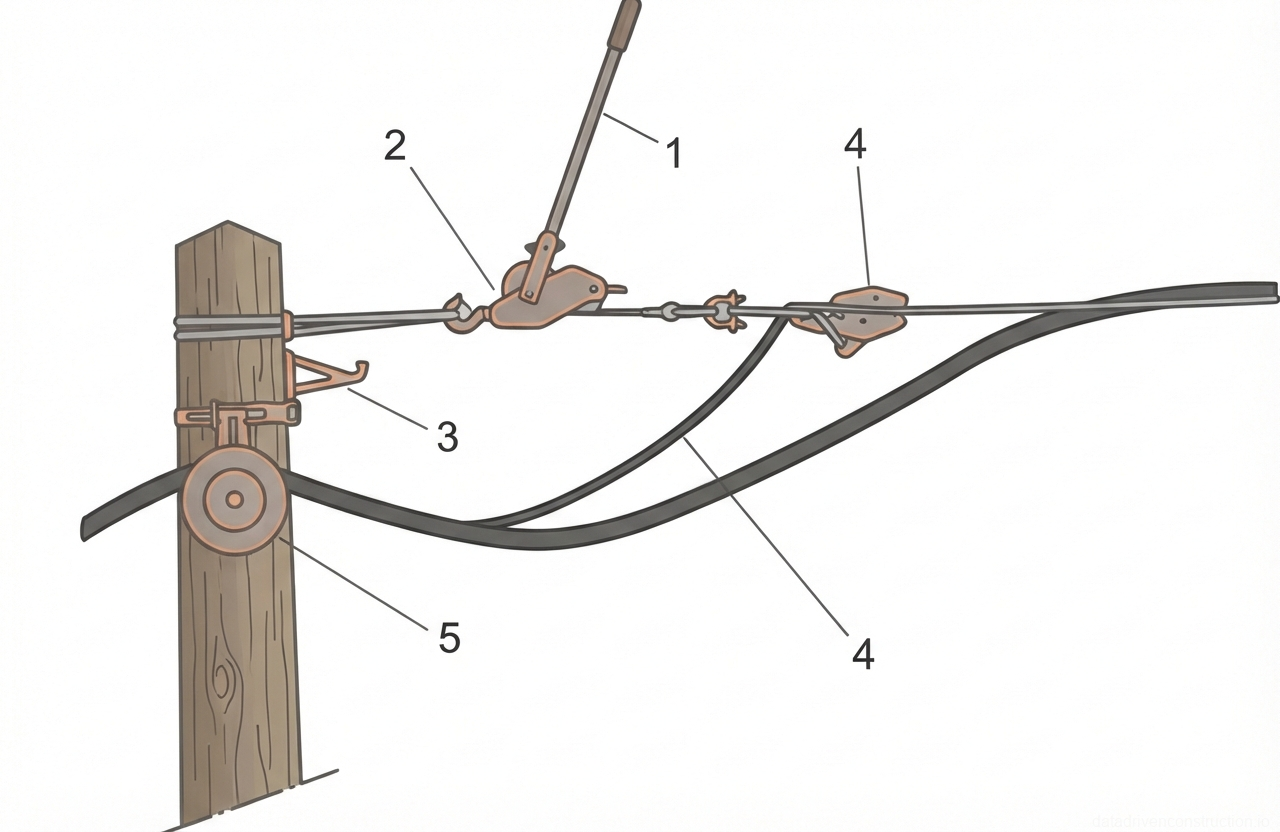
2. Preparatory Work and Crew Composition
Before commencing direct installation work for the construction of an overhead line with insulated conductors (OHL), a complex of preparatory measures must be completed. This includes preparing and clearing the OHL route in accordance with project documentation, eliminating obstacles to pole erection and conductor stringing. Poles must be assembled and installed in their design positions, and protective devices must be provided and installed at crossings over existing engineering structures. At building entries, all necessary fittings for anchoring incoming conductors must be installed, ensuring their reliable and safe connection.
Furthermore, it is crucial to ensure the timely delivery of ABC drums and all necessary stringing mechanisms directly to the installation route. This guarantees continuity of the work process and minimizes downtime. All work must be performed by qualified personnel equipped with the necessary personal protective equipment.
For installation work, it is recommended to form a crew with the following composition, ensuring optimal distribution of duties and qualifications:
* Electrical Lineman, Grade 5 (Foreman) – 1 person, responsible for overall leadership and work supervision.
* Electrical Lineman, Grade 4 – 1 person, ensuring the execution of complex installation operations.
* Electrical Lineman, Grade 3 – 2 persons, performing main installation and adjustment work.
* Driver, Grade 5 – 1 person, operating specialized transport vehicles and ensuring the movement of equipment and materials.
All crew personnel must be equipped with standard personal protective equipment: safety helmets, safety harnesses, lineman's gaffs/climbers, and protective gloves, in accordance with applicable safety standards.
3. Handling, Storage, and Transportation of Self-Supporting Insulated Conductors (ABC)
Proper handling of self-supporting insulated conductors (ABC) at all stages, from storage to installation, is crucial for maintaining their operational characteristics and longevity. ABC drums must be stored and transported exclusively in a vertical position to prevent deformation or damage to the conductor. When unloading drums from transport vehicles, it is strictly forbidden to drop them; lifting mechanisms must be used to ensure smooth movement.
When moving ABC drums, especially using forklifts or similar equipment, any contact with sharp objects that could damage the insulation or the conductor itself must be strictly avoided. To prevent further untwisting or loosening of the ABC bundle after cutting conductors or the bundle as a whole, it is recommended to use specialized sector shears, and immediately apply cable ties or strong insulation tape to the free ends of the bundle.
The lagging from the drum should not be removed until it is set up in the working position for ABC stringing; this provides additional conductor protection. When moving the drum along the ground, it should be rolled strictly in the direction indicated by the arrow on the side. However, when stringing ABC from the drum, its rotation must be opposite to ensure correct conductor feed. It is forbidden to store drums on wet, sandy, or damp soil to eliminate the risk of corrosion or contamination. It is extremely important to avoid dropping ABC directly onto the ground and then lifting and placing it into the stringing roller; stringing must be carried out directly from the drum, keeping the conductor supported in the rollers.
4. Installation, Tensioning, and Adjustment of Self-Supporting Insulated Conductors (ABC) in an Anchor Span
ABC installation in an anchor span involves the sequential execution of operations for installing the anchor clamp, securing the ABC at the first anchor pole, subsequent tensioning of the conductor, and its fixation at the second anchor pole, as well as securing it at all intermediate poles. A key stage is determining the tension of the messenger neutral conductor of the ABC, which is calculated using sag and tension charts based on the ambient air temperature, ABC brand and cross-section, and the length and geometry of the anchor span. The design tension force may be exceeded by no more than 5% to account for subsequent ABC elongation associated with the straightening of deformations after winding and storage on the drum. After tensioning the ABC, a visual assessment of the sag quality is performed, and the conductor is left to 'hang,' typically until the start of the next shift, for stabilization.
Conductor tension must be measured exclusively with a dynamometer. Failure to comply with this requirement can lead to a violation of regulatory OHL clearances, creation of unacceptable mechanical loads on the poles, which may result in their damage or collapse. ABC is suspended using specialized fastening fittings, which are attached only to the messenger neutral conductor (for main ABC lines). When calculating ABC suspension, the following standard climatic load models, applicable in most regions, must be considered:
1. Temperature +40°C, no wind or ice.
2. Temperature -40°C, no wind or ice.
3. Conductors covered with ice, temperature -5°C, no wind.
4. Wind pressure 26.5 daN/m² at -5°C, no ice.
5. Conductors covered with ice, temperature -5°C, wind pressure 6.65 daN/m².
Regardless of specific climatic conditions (wind pressures, temperature, snow accumulation, ice and rime deposits), the force applied to the messenger neutral conductor of the ABC must not exceed 700 daN. The tension during ABC suspension on 0.4 kV OHL poles is determined by special installation tables or graphs that account for the span length and design parameters. This ensures that sag values comply with design specifications and the overall structural reliability of the line. For sections up to 150 m long, consisting of one, two, or three spans up to 50 m long, bounded by anchor poles, the tensioning device is attached to the top of the terminal anchor pole.
- 1. Install the anchor clamp on the messenger neutral conductor at the terminal (anchor) pole. Apply a plastic cable tie to the ABC bundle near the anchor clamp to prevent the bundle from untwisting.
- 2. Suspend the clamp on the bracket of the terminal pole.
- 3. Simultaneously reel in excess ABC onto the drum, ensuring minimal slack.
- 4. Install a pulling grip on the messenger neutral conductor, as far into the span as possible. Attach a dynamometer and a manual winch to it, previously secured to the first pole of the line.
- 5. Tension the ABC using the manual winch, constantly monitoring the force with the dynamometer until the design value is reached.
- 6. Secure the clamp on the bracket and install it on the messenger neutral conductor.
- 7. Remove the manual winch.
- 8. Secure the conductors together with a cable tie for fixation.
- 9. For adjusting ABC on OHL sections where a ground-mounted tensioning device is used, install and remove it, gradually increasing the ABC tension at the top of the terminal pole before installing the clamp.
- 10. After paying out ABC along the entire length of the OHL and completing the first anchor attachment, the ABC is supported by a ground-mounted tensioning device at the end of the OHL.
- 11. Adjustment of the first section is performed using the anchor attachment, which requires installing a guide roller on a double bracket parallel to the stringing roller.
- 12. Adjustment of the remaining OHL sections is performed similarly, with the last attachment adjusted as in a single span. Two tensioning devices are used (one at the end of the OHL, the other on a double bracket) to simultaneously adjust the first span and the required flexibility of the attachment.
- 13. Mark the position of the tension clamp, install it, create additional tension, and attach the clamp to the bracket, then release and remove the tensioning device.
5. Quality Requirements, Control, and Work Execution Conditions
To ensure high quality and longevity of an overhead line with self-supporting insulated conductors (ABC OHL), installation work must be performed strictly in accordance with the developed technology and applicable standards. The use of specialized line fittings, mechanisms, accessories, and tools is recommended. Installation is permitted at ambient air temperatures not lower than minus 20°C to avoid insulation damage and ensure the required material plasticity.
Key quality requirements for the work include:
* **Thorough route preparation:** Clearing of the right-of-way, removal of trees or large branches that may obstruct pole installation, stringing, and adjustment of conductors is mandatory. Improper clearing can lead to ABC damage or compromised operational safety.
* **Dismantling of old structures:** When constructing a new OHL to replace a dilapidated one on the same route, the old line structures must be completely dismantled before the new poles are installed, to eliminate interference and potential hazards.
* **Protection of conductor insulation:** All possible measures must be taken to prevent damage to the insulating coating of the ABC during stringing and adjustment. This includes preventing contact of conductors with the ground, concrete and metal structures, and large tree branches. The use of protective rollers and guides is mandatory.
* **Conductor stringing under tension:** Conductors must be strung under controlled tension to avoid sagging, tangling, and damage to the conductor. This also contributes to the uniform distribution of stress in the conductors.
* **Personnel qualification:** Conductor installation is recommended to be entrusted only to specially trained crews from construction and installation or operational organizations with relevant experience and permits.
* **Tension and sag control:** Installation tensions and sag values specified in the project documentation and sag and tension charts must be strictly adhered to. Overtensioning of conductors is strictly unacceptable, as it can lead to premature wear, insulation damage, or breakage of the messenger conductor.
6. Material and Technical Resources and Technical-Economic Indicators
Effective and high-quality ABC installation requires an appropriate set of material and technical resources. Below is an approximate demand for mechanization means, accessories, tools, and materials for ABC installation in an anchor span up to 500 m long, as well as general technical-economic indicators calculated per 1 km of suspended ABC.
**Mechanization means, accessories, and tools:**
* Tensioning device (for ABC with 50-70 mm² cross-section) – 1 unit.
* Manual winch (pulling force up to 500 daN) – 1 unit.
* Dynamometer (for force measurement up to 500 daN) – 1 unit.
* Temporary anchor (as needed) – 1 unit.
* ABC cutting shears (sector type) – 1 unit.
* Anchor bracket (for ABC fastening) – required quantity.
* Anchor clamp (for ABC 1500 series) – required quantity.
* Intermediate suspension kit (for ABC 1500 series) – required quantity.
* Separating wedges (as needed) – required quantity.
**Technical-economic indicators (per 1 km of suspended ABC-2, ABC-2A 1 kV conductor):**
* Labor costs for construction workers: 209.7 person-hours (average work grade determined according to internal regulations).
* Machine operator labor costs: 64.72 machine-hours.
**Main machines and mechanisms (per 1 km of conductor):**
* Rail trolleys with crane (3.5 t lifting capacity) – machine-hours according to standard.
* Overhead line stringing machines (for off-rail operation) – machine-hours according to standard.
* Rail platforms (71 t lifting capacity) – machine-hours according to standard.
* Truck-mounted auger-crane machines (drilling depth up to 3.5 m) – machine-hours according to standard.
**List of main materials (per 1 km of conductor):**
* Galvanized steel tie wire, 2 mm diameter (for overhead communication lines).
* Insulation-piercing branching clamp (for ABC).
* Single anchor attachment kit (comprising: bracket, clamp).
* Double anchor attachment kit (comprising: bracket, 2 clamps).
* Intermediate suspension kit (for ABC).
* Cable tie (for ABC).
* Stainless steel strapping band, 20 mm width, 0.7 mm thickness, 50 m length.
* Buckle for strapping band, 20 mm size.
* Insulated joint clamp (for ABC).
* Insulated aluminum lug with copper terminal (for ABC).
* Reinforced concrete extensions (if required).
* Bare copper conductors, M brand, 10 mm² cross-section (0.075 km).
* Self-supporting insulated conductors (1000 m).
* Sealing caps (for ABC).
7. Safety and Labor Protection
Work safety during ABC installation is a priority and must be ensured by a comprehensive system of organizational and technical measures. These measures are aimed at preventing the impact of hazardous production factors on personnel and the environment, as well as minimizing the risks of emergency situations.
All protective equipment, accessories, and tools used for servicing overhead lines must undergo timely inspection and testing in accordance with established standards and instructions. Regular inspection and maintenance of equipment in proper condition are critically important for ensuring personnel safety. Overhead power lines must always be in technically sound condition, guaranteeing safe working conditions, electrical safety, and environmental protection.
OHL must be equipped with tested and ready-for-immediate-use protective equipment, as well as all necessary first aid supplies in accordance with current rules and regulations. Personnel must be trained in the use of these means and in providing first aid. Organizations responsible for performing work must continuously monitor compliance with the requirements of this technological map, labor protection instructions, and the quality of all types of safety briefings. Responsibility for the overall state of labor protection on the line rests with the owner or operating organization.