Construction Technology Card: Reinforcement of Ring Foundation for a Tank
Materials
- Flat reinforcing meshes: corresponding to design specification, steel grade according to applicable international standards (e.g., EN 10080 or ASTM A615).
- Concrete spacers: made of concrete class not lower than C12/15 (M150), ensuring the designed concrete cover layer thickness.
- Rolled waterproofing material: bitumen-based, for a two-layer base waterproofing system.
- Bitumen mastic: for adhering rolled waterproofing material and creating a watertight layer.
- Protective gloves: for workers during manual rebar handling.
Equipment
- Freight vehicle: for delivering reinforcing meshes and other materials to the site.
- Steel pry bar: for auxiliary work in moving and positioning.
- Bucket: for small materials or waste.
- Folding steel tape measure: for performing measurements and dimensional control.
- Plumb bob: for vertical alignment of structures.
- Personal protective equipment: hard hats, protective gloves, safety footwear.
1. General Provisions and Scope
This construction technology card covers the complete scope of work for the reinforcement of a ring foundation for a cylindrical prefabricated reinforced concrete tank, designed for oil storage, with a nominal capacity of 10,000 m³. The methods and procedures presented comply with the general principles of standard design and are applicable to a wide range of construction projects.
The card serves as a basis for developing detailed work execution plans (WEPs) for construction sites, as well as a practical guide for supervisory personnel on construction sites – engineers, supervisors, and foremen. Its application contributes to process standardization, optimization of labor resources, and ensuring high quality of work performed.
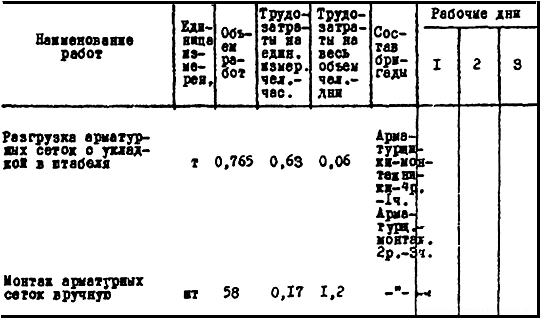
When adapting this card to specific construction site conditions, it is necessary to clarify the scope of work, the list of mechanization means to be used, and the requirements for material resources. However, the main technological methods of work performance described in the card must be maintained or improved to enhance the efficiency and safety of the process. The reinforcement work for the entire volume of the ring foundation is carried out by a rebar fitters crew of 4 people over an estimated period of 0.3 days.
2. Technical and Economic Performance Indicators
The technical and economic performance indicators presented below reflect the calculated efficiency and labor input for the entire scope of work on reinforcing this type of tank's ring foundation. This data can be used for resource planning, work scheduling, and preliminary project cost estimation.
The total labor intensity for the entire scope of work is 1.26 person-days. When recalculated per unit of rebar mass, the labor intensity per 1 tonne of rebar is 1.632 person-days. This allows for assessing crew efficiency and planning productivity.
The average output per worker per shift is projected at 0.61 tonnes of rebar. The total duration of work for reinforcing the ring foundation, based on these indicators and crew composition, is 0.3 days.
3. Preparatory Works and Material & Technical Support
Before commencing the direct work on reinforcing the ring foundation, a set of preparatory measures must be carried out to ensure continuity and safety of the process. The most important step is the completion of the waterproofing layer installation. This layer, consisting of two layers of rolled waterproofing material on bitumen mastic, must be fully installed and checked for watertightness.
Simultaneously, the working area is prepared: installation of tools, fixtures, and occupational safety equipment. Special attention is paid to organizing the area for temporary storage of reinforcing meshes, which must be level, cleared of foreign objects, and easily accessible for access equipment. All necessary materials and products, including reinforcing meshes, concrete spacers, waterproofing materials, and mastic, must be delivered to the site and stored in accordance with storage requirements.
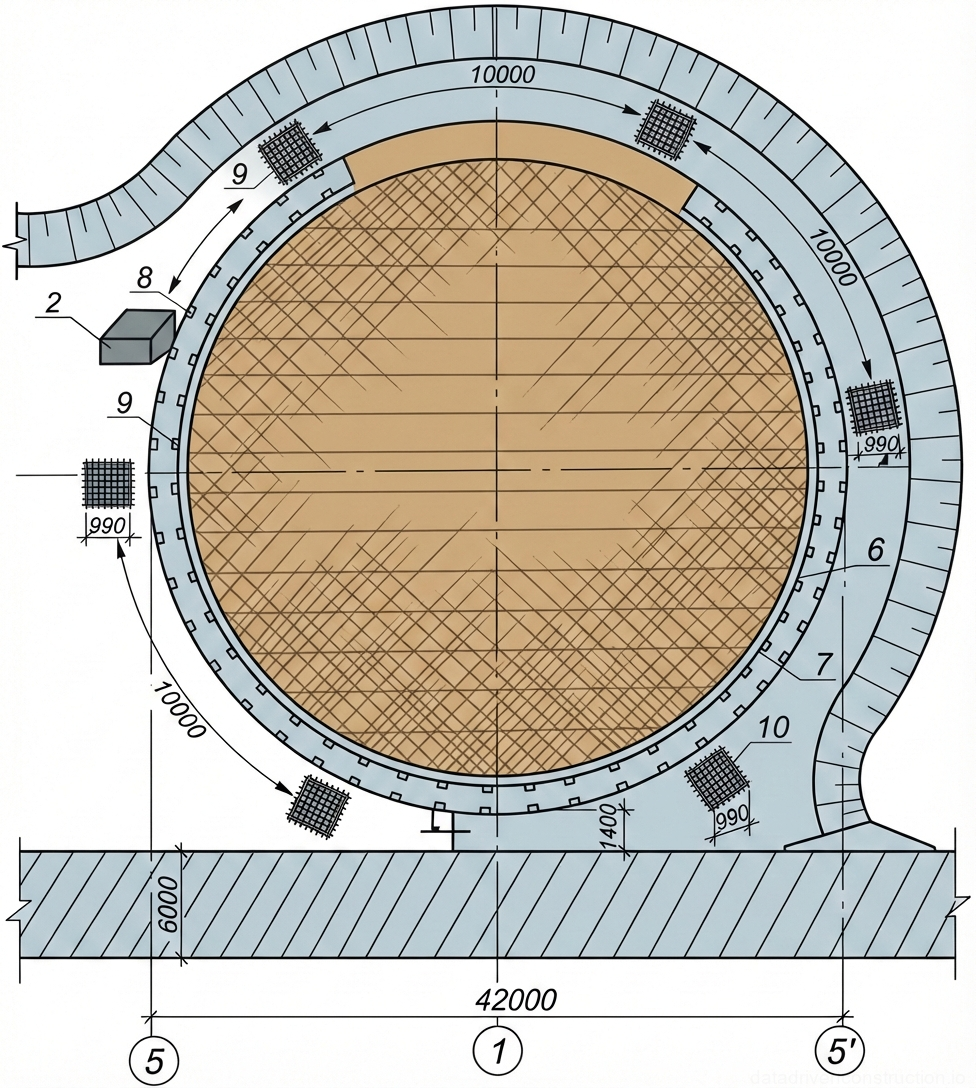
The placement of tools, fixtures, and light mechanization equipment in the working area must be optimal to ensure quick access and minimize worker movements. The approximate layout provides for stacks of reinforcing meshes along the foundation perimeter, boxes with concrete spacers, and rolls of waterproofing material. For this type of foundation, 6 stacks of flat reinforcing meshes, 10 pieces each, are required, positioned around the perimeter to minimize carrying distance (up to 10 m).
- Complete the installation of the base waterproofing: lay two layers of rolled waterproofing material on bitumen mastic.
- Prepare and install all necessary tools, fixtures, and safety equipment in the crew's working area.
- Prepare and clear the area for storing reinforcing meshes, ensuring its accessibility for unloading.
- Receive and deliver all materials and products required for reinforcement work to the site (reinforcing meshes, concrete spacers, waterproofing materials, mastic).
4. Reinforcing Mesh Installation Technology
The installation of flat reinforcing meshes for the ring foundation is carried out manually, requiring coordinated crew work and strict adherence to the sequence of operations. Flat reinforcing meshes, delivered by freight vehicle, are unloaded by the rebar fitters crew and stacked (10 meshes per stack) around the foundation perimeter, as specified in Section 3, to ensure a minimum carrying distance to the placement location. Each mesh weighs approximately 13.2 kg.
The laying process begins with base preparation. A rebar fitter-assembler lays out concrete spacers on the concrete blinding of the ring foundation. These spacers are critically important for forming the concrete cover layer of the required thickness, ensuring the correct design position of the reinforcement and its protection from corrosion. The use of spacers must comply with project requirements, typically providing a concrete cover layer of at least 30-40 mm for foundations.
Then, rebar fitter-assemblers manually, using protective gloves, carry the reinforcing meshes from the stacks to the placement location and carefully position them on the prepared concrete spacers. When laying the meshes, the rebar fitters ensure precise positioning and splicing of the mesh bars. Alignment of the meshes is performed according to design elevations and axes, taking into account permissible deviations. Subsequent meshes are laid similarly, forming a continuous reinforcement belt for the foundation.
- Unloading of flat reinforcing meshes from the truck and stacking them in six stacks (10 meshes each) around the tank perimeter, ensuring a minimum carrying distance (up to 10 m).
- Base preparation: a rebar fitter-assembler (A2) carries and lays out concrete spacers on the concrete blinding of the ring foundation to form the concrete cover layer.
- Carrying reinforcing meshes: rebar fitter-assemblers (A3 and A4) approach a stack, manually (wearing protective gloves) pick up a reinforcing mesh (weighing 13.2 kg) by its edges, and carry it to the placement location.
- Laying reinforcing meshes: rebar fitters (A3 and A4) carefully lay the mesh onto the prepared concrete spacers, positioning them under the bar splices of the mesh.
- Aligning meshes: rebar fitters (A1 and A2) alternately or jointly perform the laying and alignment of meshes according to design axes and elevations, ensuring installation accuracy.
5. Work Organization and Personnel Composition
Work on reinforcing the ring foundation is performed by a specialized crew of rebar fitters-assemblers. Each assembly crew consists of four people, which allows for efficient distribution of duties and optimization of operation sequence. Such work organization ensures high productivity and minimizes task completion time.
The crew composition by profession and grade includes: one 4th-grade rebar fitter-assembler (crew leader, A1) and three 2nd-grade rebar fitter-assemblers (A2, A3, A4). The crew leader (A1) is responsible for overall work coordination, quality control, and mesh alignment. Rebar fitters (A2, A3, A4) perform the main operations of unloading, carrying, laying out spacers, and placing meshes.
Duties are distributed as follows: rebar fitter-assemblers A2, A3, A4 actively participate in unloading reinforcing meshes from vehicles and stacking them. A2 also handles the installation of concrete spacers, while A3 and A4 are responsible for carrying and installing meshes. All crew members participate in aligning the installed meshes to ensure compliance with design requirements. The total labor input for unloading meshes and stacking them is 0.276 person-hours, and for manual installation of reinforcing meshes weighing up to 20 kg – 5.046 person-hours for the entire scope of work, leading to a total labor input of 10.34 person-hours for the entire reinforcement cycle.
6. Quality Control and Safety Requirements
Quality control of reinforcing mesh installation is a critically important stage to ensure the durability and reliability of the entire structure. Quality is determined by strict adherence to tolerances and deviations from the design position, as established in applicable building codes and international standards (e.g., ISO 19686 for concrete structures execution). Particular attention is paid to the concrete cover layer thickness, the accuracy of the reinforcement cage geometry, and the reliability of connections.
Continuous monitoring of the following parameters is necessary: placement of reinforcing meshes relative to the foundation axes and elevations, adherence to the design concrete cover layer thickness through proper use of concrete spacers, absence of reinforcement deformations, and correctness of laps and fastenings. All identified deviations from the design documentation must be immediately corrected before concreting begins.
During installation works, occupational safety and health rules must be strictly observed. This includes the use of personal protective equipment (hard hats, protective gloves, safety footwear), ensuring safe passages and workplaces, and fencing off hazardous areas. Special attention should be paid to rules for manual loading and carrying of heavy loads. Work should be performed under conditions that prevent objects from falling from height and ensure the stability of all structures. Work is not permitted under unfavorable weather conditions, such as strong wind, snowfall, black ice, or heavy rain, which could affect the safety and quality of installation.
- Verification of the completed waterproofing layer for integrity and watertightness.
- Visual inspection of the rebar storage area: levelness, cleanliness, accessibility.
- Quality and quantity control of delivered reinforcing meshes and concrete spacers for compliance with design specifications.
- Alignment of concrete spacers on the foundation base: compliance with the concrete cover layer thickness (e.g., 30-40 mm).
- Checking the correctness of reinforcing mesh placement: compliance with design axes, elevations, geometry, and dimensions; control of permissible deviations from the design position, which should not exceed ±10 mm for axes and ±5 mm for height for reinforcing bars and ±15 mm for cages and meshes within the foundation.
- Ensuring a safe workplace: presence of railings, absence of foreign objects, adequate lighting, use of personal protective equipment.