Construction Technology Card: Dismantling of Inter-story Wooden Joist Floors during Building Reconstruction
Materials
- Sawn timber for temporary walkways and decks (boards with a cross-section of at least 50x150 mm)
- Smooth reinforcing steel (S235 / A-I) Ø12-14 mm (cut into 1.0 m lengths for fixing staples)
- Waterproofing bituminous mastic / coal-tar varnish (for treating wood cuts)
- Wooden shields 1.5x1.5 m for load distribution from waste containers
- Technical water (for backfill dust suppression)
Equipment
- Tower crane or self-propelled pneumatic-tired jib crane (lifting capacity according to the Work Execution Plan)
- Inventory telescopic props and prefabricated demountable towers (load-bearing capacity up to 8 tons, height up to 8 m)
- Pneumatic chipping hammers (compressor station)
- Inventory waste containers / self-unloading bins
- Two-leg slings (2SK) and textile ring slings (STK), hemp tagline ropes
- Specialized hand tools: crowbars, nail pullers, plastering hammers, sledgehammers
- Scaffolding means: installer's inventory platforms
1. Engineering Preparation and Ensuring Spatial Rigidity
Prior to the commencement of dismantling works, a comprehensive instrumental inspection of the structures is carried out to identify elements that have lost their load-bearing capacity. The building or the work section must be completely evacuated, and utility networks (water supply, electricity, HVAC) must be disconnected and dismantled. Scaffolding equipped with protective catch netting is installed along the facade perimeter, and areas for storing sorted materials and placing waste accumulation bunkers are organized on the site.
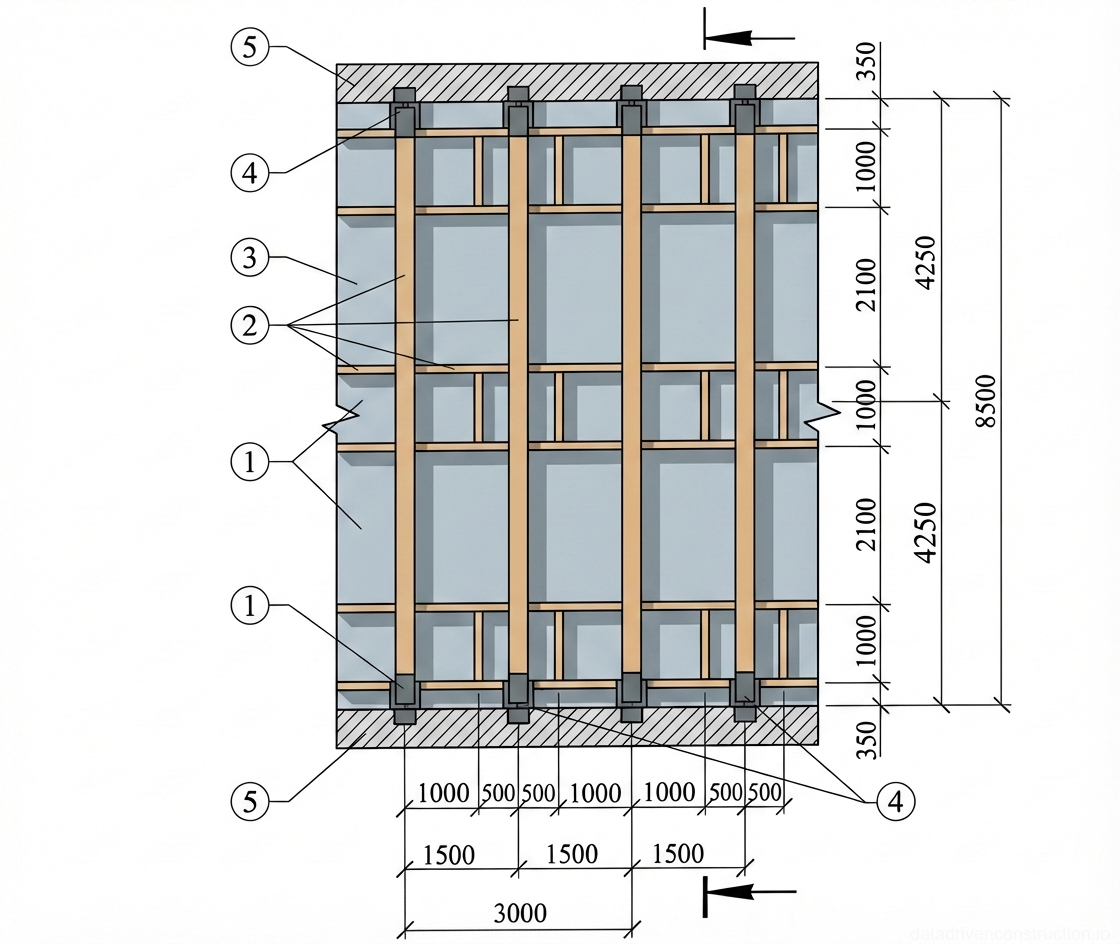
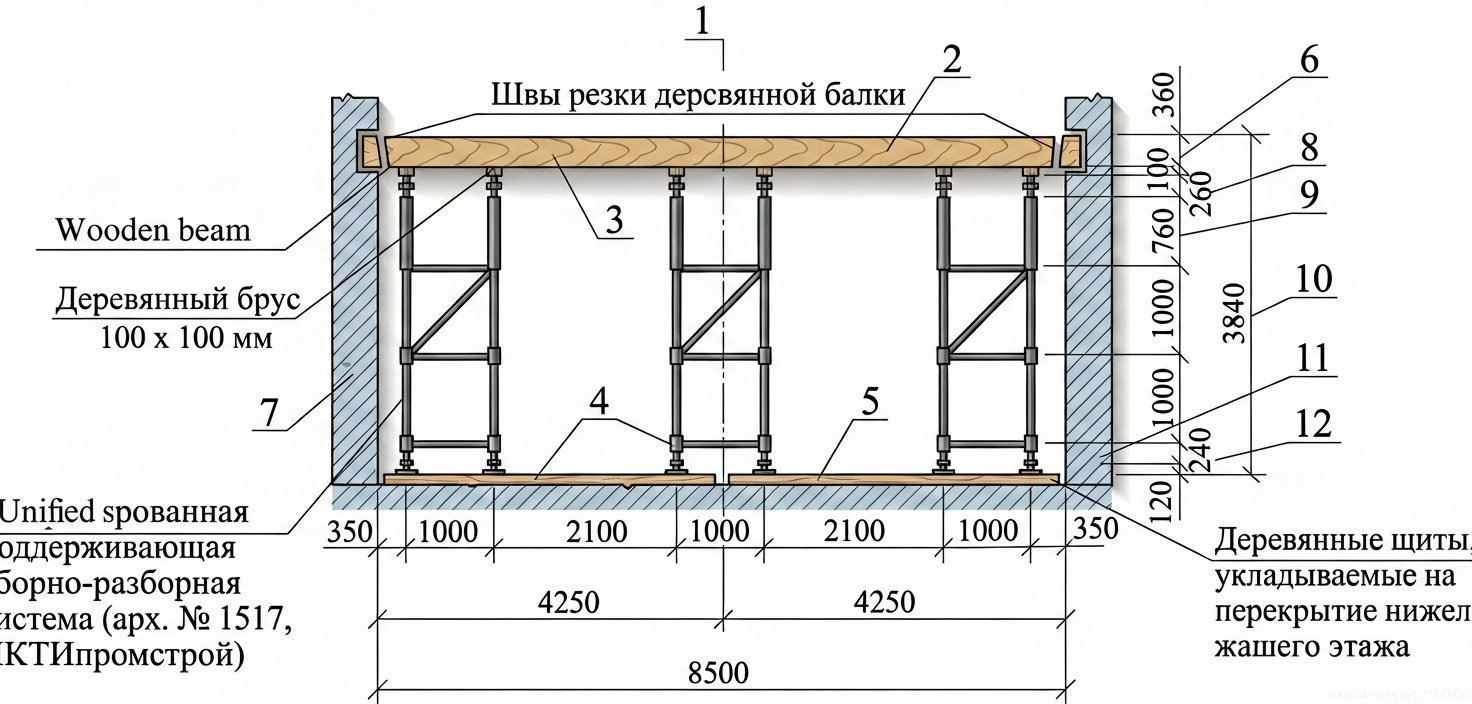
The critical stage of preparation is ensuring the stability of the elements to be retained. The dismantling of the floors is preceded by the dismantling of the overlying roof structures and the punching of design openings. Temporary supporting systems are installed under elements threatening to collapse. As the main equipment, prefabricated demountable scaffold towers with a base size of 1.0 x 1.0 m, adjustable in height up to 8.0 m and having a load-bearing capacity of up to 8 tons per strut, are used. The towers are connected by horizontal and vertical ties to ensure geometric immutability.
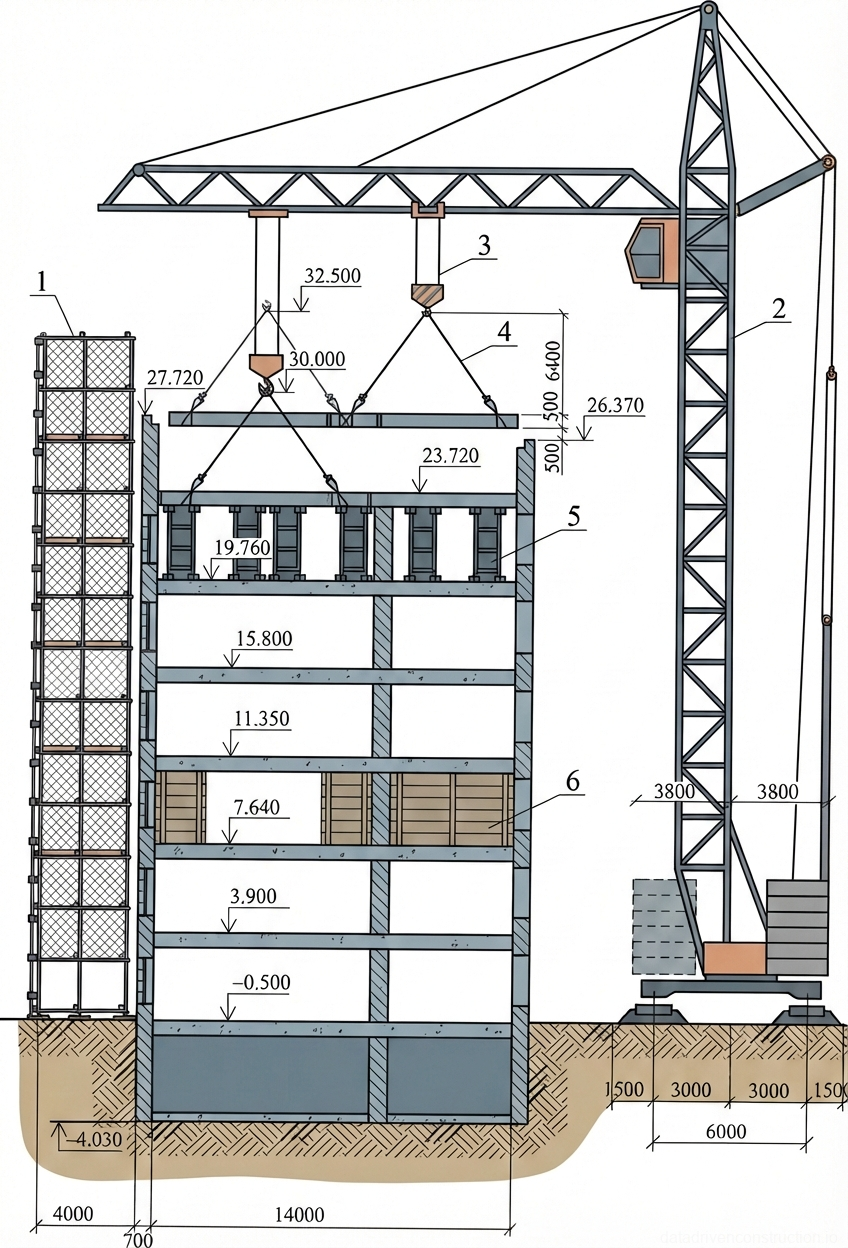
To move loads, a tower, truck, or pneumatic-tired crane of appropriate lifting capacity is used. The crane's operating radius, storage zones, and equipment movement paths are determined by the Work Execution Plan (WEP). All working zones with a height difference of 1.3 m or more are equipped with temporary protective guardrails not less than 1.1 m high.
- Conduct a technical inspection of the building, draw up a structural condition report, and disconnect utility networks.
- Fence off hazardous zones, assemble facade scaffolding with netting, and organize storage areas.
- Install temporary repositionable props (towers) under defective sections of the floors being dismantled and the floors below.
- Equip construction waste reception zones and prepare hoisting machinery for operation.
2. Dismantling of Floor Coverings and Installation of Walking Decks
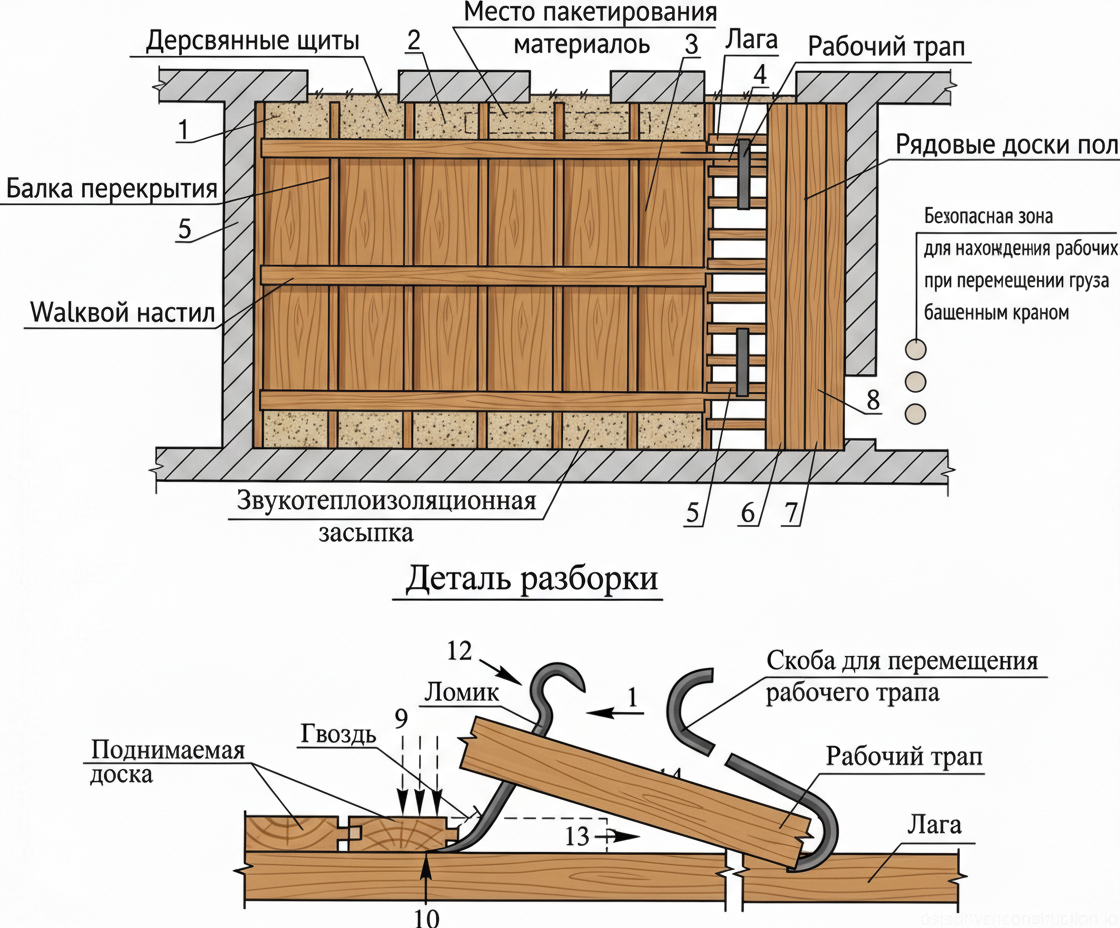
Dismantling of the inter-story floor elements is carried out strictly from top to bottom, in the reverse order of assembly, starting from the point of the work section furthest from the exit. The process begins with the removal of skirting boards, cove moldings, and ventilation grilles using specialized crowbars. To preserve the integrity of the tongue-and-groove boards (without damaging the tongue and groove), the board is slightly pried off the joist with a crowbar, after which it is knocked down with hammer blows. Boards freed from nails are bundled.
The dismantling of parquet floors depends on their type. Block parquet is removed block by block. Panel parquet is preliminary sawn along the glued squares, after which the intact panels are pried off the subfloor with crowbars. All dismantled timber suitable for reuse is stacked in bundles on wooden spacers at a distance of no more than 1.5 m from the load-bearing masonry walls to minimize bending moments in the floor.
A mandatory safety condition is the installation of temporary walking decks. Walkways made of 2-3 boards (with a total width of about 0.5 m) are laid over the exposed joists with a spacing of 1.5–2.0 m. For secure fixing of the walkways to the joists, metal staples made of smooth reinforcing steel (grade S235 / A-I) with a diameter of 12...14 mm and a length of 1.0 m are used. These decks serve as evacuation routes and working platforms until the complete removal of the joists.
- Dismantle skirting boards, cove moldings, and floor grilles.
- Remove the frieze board to create an initial gap.
- Remove ordinary tongue-and-groove boards or parquet panels, preserving the connection elements.
- Install walking walkways made of 2-3 boards along the joists, securing them with metal staples.
- Remove the joists and form timber bundles for crane lifting.
3. Extraction of Insulation Backfill and Dismantling of Inter-joist Infill
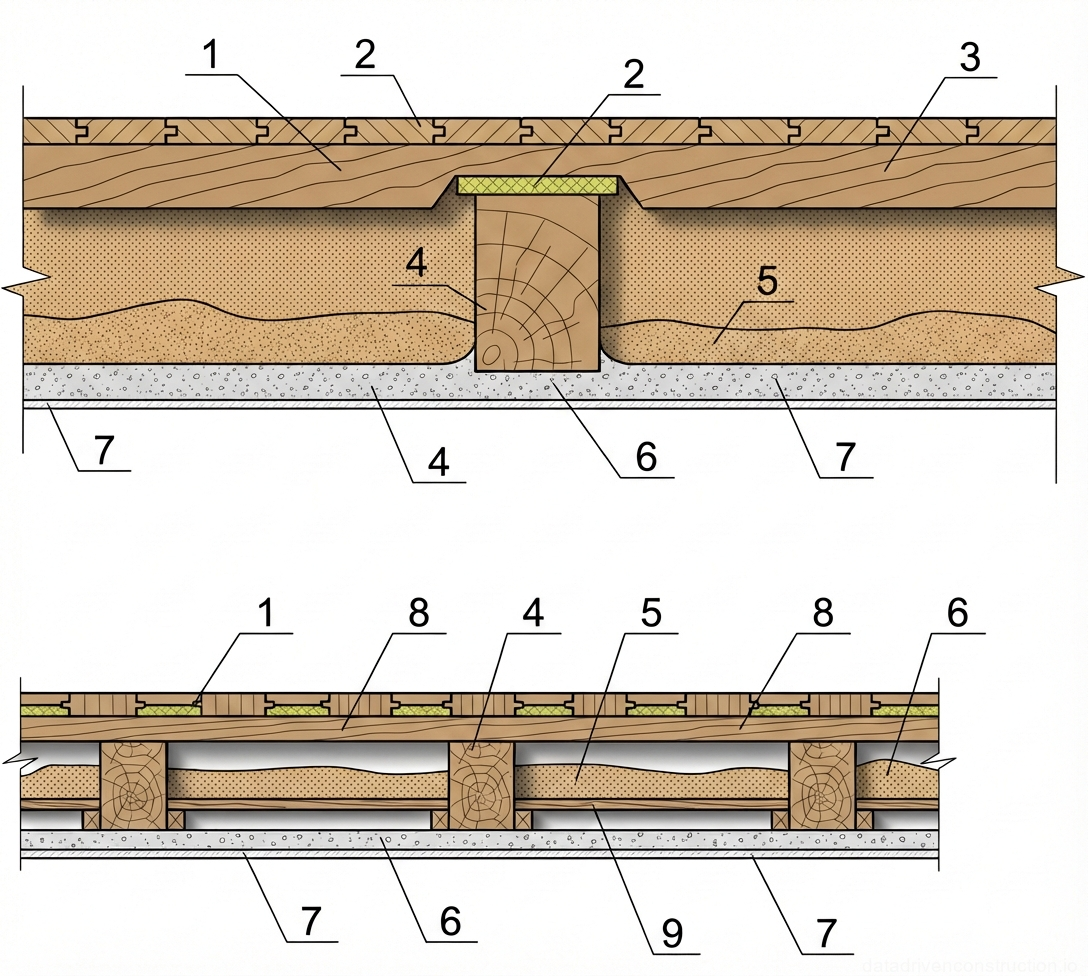
After removing the joist base, access to the sound and thermal insulation backfill (lubrication) is opened. The compacted material is pre-loosened using pneumatic chipping hammers or manual crowbars. When working in dry and windy weather conditions, to comply with ecological and sanitary dust suppression standards, the backfill must be moistened with dispersed water.
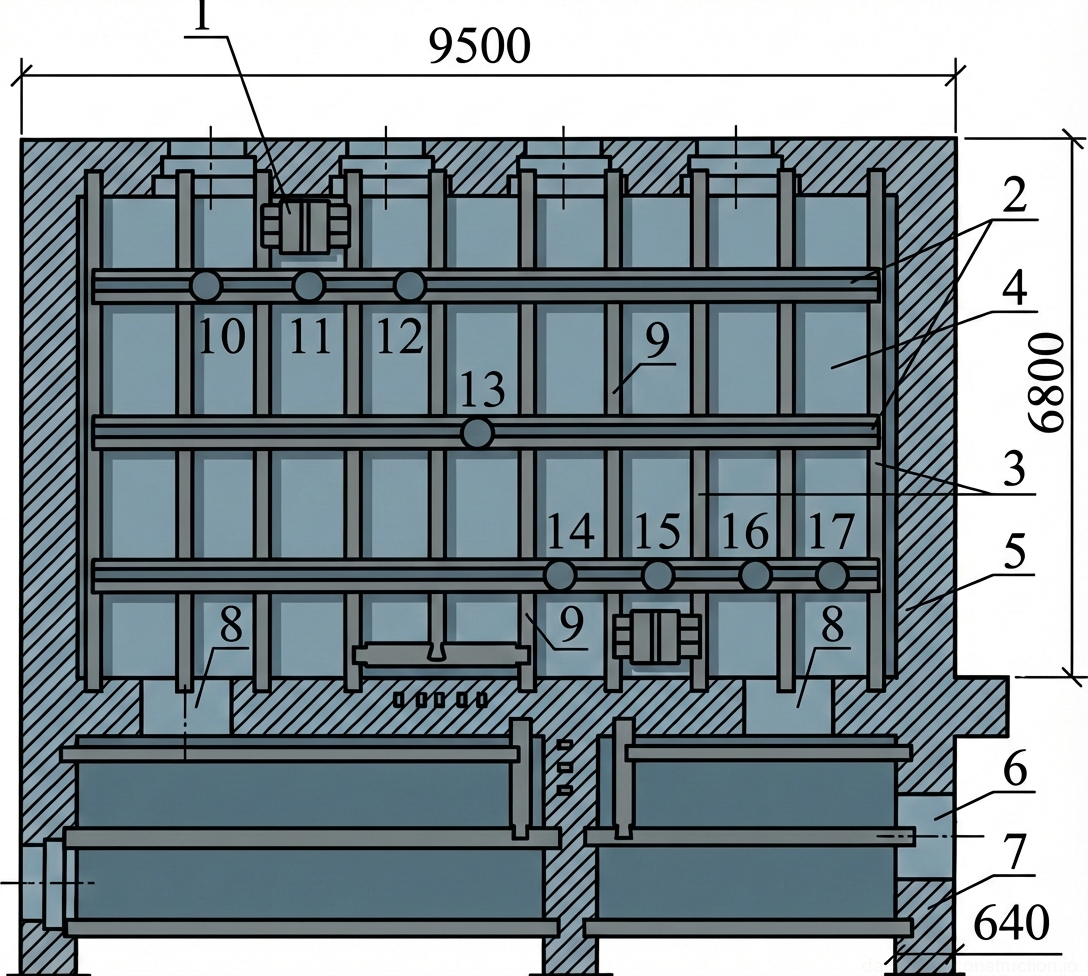
The loosened backfill is removed with square-point shovels into special inventory containers or self-unloading bins. The containers are placed on special wooden distribution shields, which are laid across two adjacent floor beams. To avoid exceeding the permissible bending loads on the old beams, the shields are placed at a distance of no more than 1.5–2.0 m from the points where the beams are embedded into the load-bearing brick walls.
The wooden sub-boarding (false ceiling) is dismantled with special small crowbars from the walking decks. The sub-boarding planks are stacked in bundles on spacers over the load-bearing beams. If the beams have grooves, the sub-boarding planks are extracted by rotating them in a horizontal plane until the ends completely exit the groove space. Filled containers and sub-boarding bundles are moved by crane to a transport vehicle or a site storage area.
- Moisten the insulation backfill for dust suppression.
- Loosen the backfill mass with a pneumatic tool.
- Install distribution shields and containers within 1.5-2.0 m of the beam supports.
- Load the backfill into containers and perform a crane lift.
- Dismantle the wooden sub-boarding planks from the working walkways.
4. Dismantling of Ceiling Boarding
The dismantling of the boarded ceiling requires high caution and is performed using a combined method. Initially, the work is carried out from the floor below: using the installer's inventory platforms along the entire perimeter of the room at the junctions of the ceiling to the walls, a layer of plaster is knocked off. The width of the knocked-off strip must be at least 200 mm. Construction waste is immediately piled up and removed from the walls to ensure free movement.
The main tearing off of the boarding is done from above, from the walking walkways laid on the floor beams. Workers, with synchronous blows of crowbars on the boarding in the areas adjacent to the beams, tear off sections of boards, collapsing them onto the underlying floor. After the formation of a technological gap with a width of at least 1.0 m, further piece-by-piece dismantling of the boards can be carried out with nail pullers directly from the level of the underlying floor.
In order to prevent occupational injuries, all protruding nails in the dismantled boarding boards must be immediately bent over or pulled out. Prepared boards are bundled and removed by a tower crane through the formed through-openings in the floor. Personnel movement to a safe zone during crane operation is carried out exclusively along the installed walking decks.
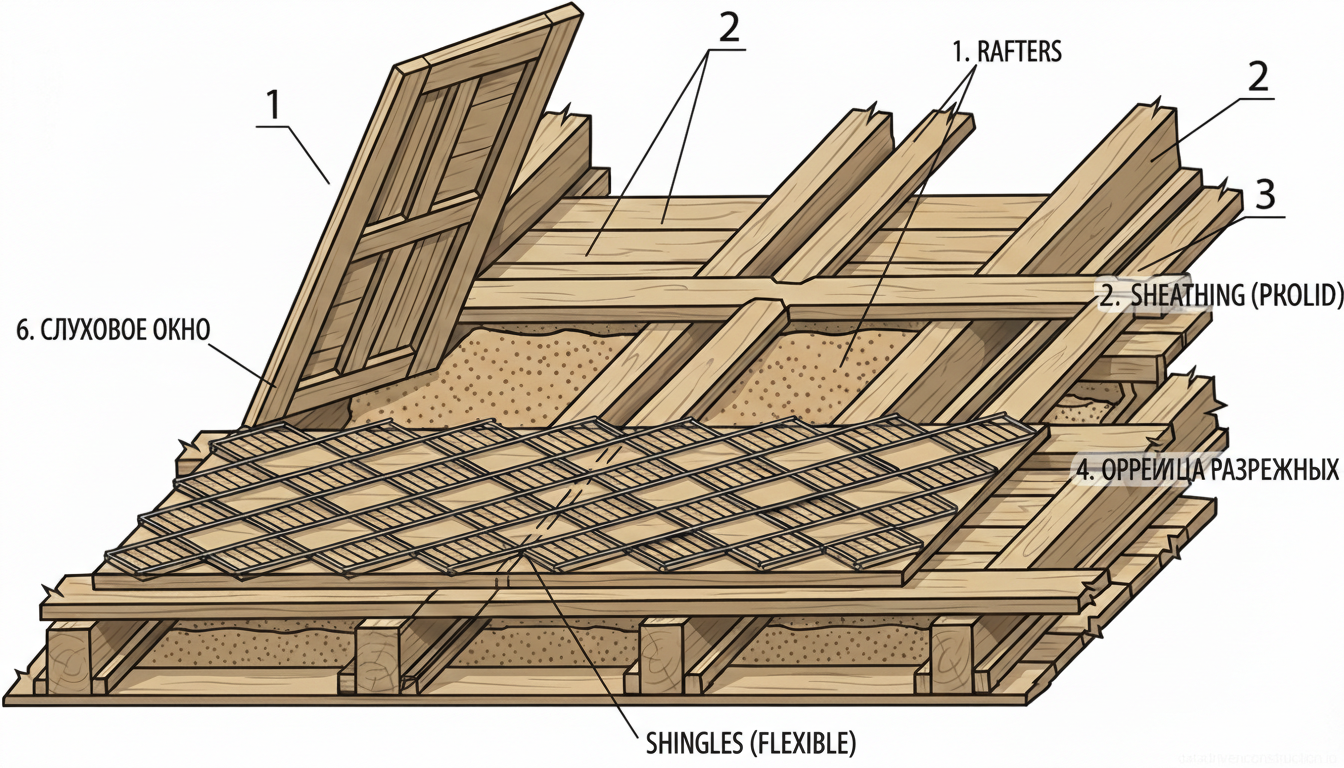
- Knock off a 200 mm strip of plaster along the ceiling contour from the floor below.
- Knock down the starting section of the boarding (at least 1.0 m wide) with crowbars from the upper-level walking decks.
- Descend to the floor below and continue piece-by-piece dismantling of the boarding with nail pullers.
- Remove or bend over protruding nails.
- Form rigging bundles from the removed boards.
5. Technology for Dismantling Load-Bearing Wooden Beams
Before removing the load-bearing wooden beams, they are supported at three points: at both supports (near the walls) and in the middle of the span. For this, inventory repositionable telescopic props are used. The release of the beam ends from the brickwork is carried out with pneumatic hammers; the pockets are widened just enough to extract the timber. Existing metal anchors are bent aside with crowbars and retained in the wall body for possible use when installing new floors.
Beams that are in satisfactory condition are sawn at the supports. Elements affected by rot or woodborers are additionally sawn in the middle of the span. The slinging of the beam is carried out with a two-leg sling and ring hitches at two points located at a calculated distance from the transverse cut locations. Hemp taglines must be attached to the cut element to control rotation.
The crane lifting algorithm is strictly regulated: the element is lifted 0.3 m above its design position to check the reliability of the slinging. After confirming the balance, the beam is lifted 0.5 m above the upper dimension of the building, after which the crane jib is smoothly moved to the storage zone. The cut areas of the dismantled beams are cleaned and treated with waterproofing mastic or bituminous varnish. IMPORTANT: in the absence of internal load-bearing walls, to preserve the spatial rigidity of the building, every fourth anchored beam is kept in place until the installation of the steel ties of the new floor.
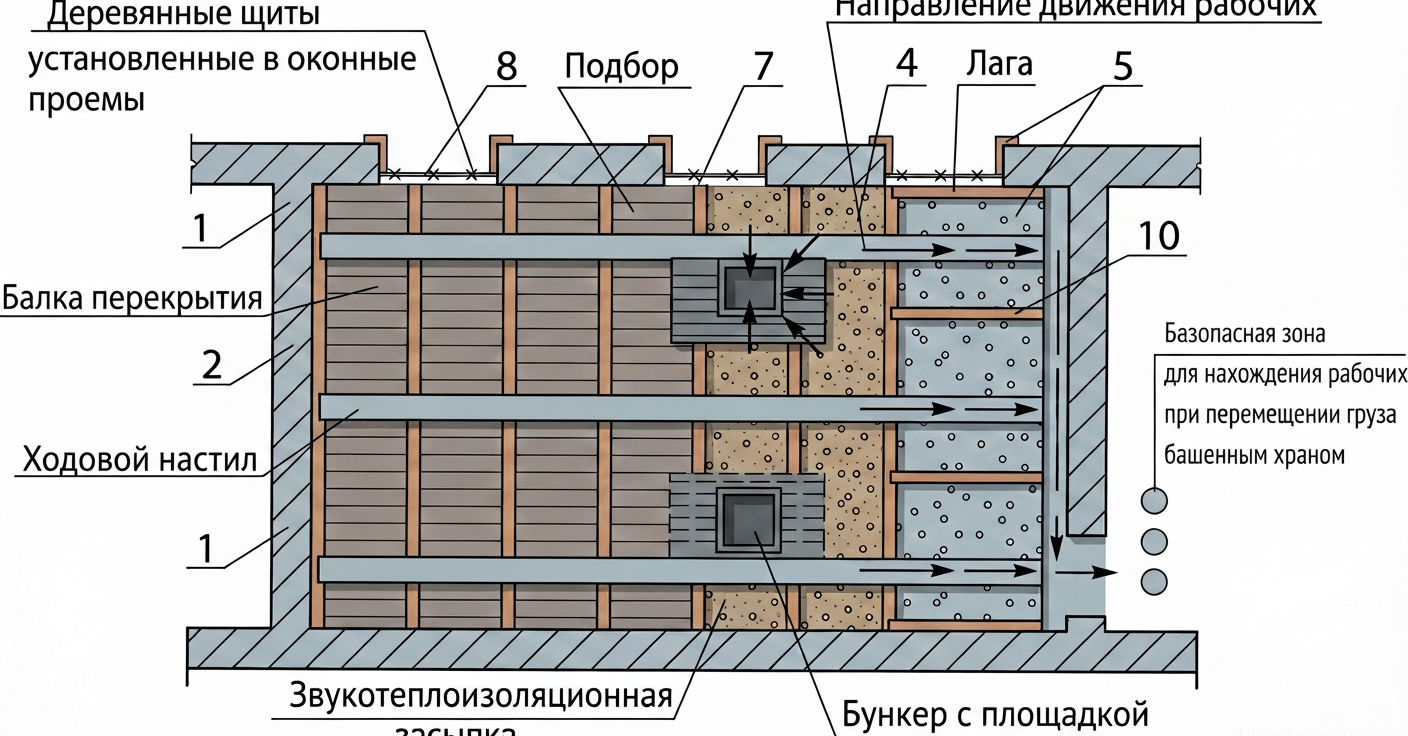
- Support the dismantled beam with telescopic props in the middle and at the edges.
- Open the beam embedment in the wall with a pneumatic tool and bend the metal anchors aside.
- Sling the beam at two points and attach hemp taglines.
- Perform a transverse saw cut of the beam.
- Lift the load by 0.3 m (test lift), then 0.5 m above the building and move it to the storage.
6. Labor Organization, Norm Control, and Crew Management
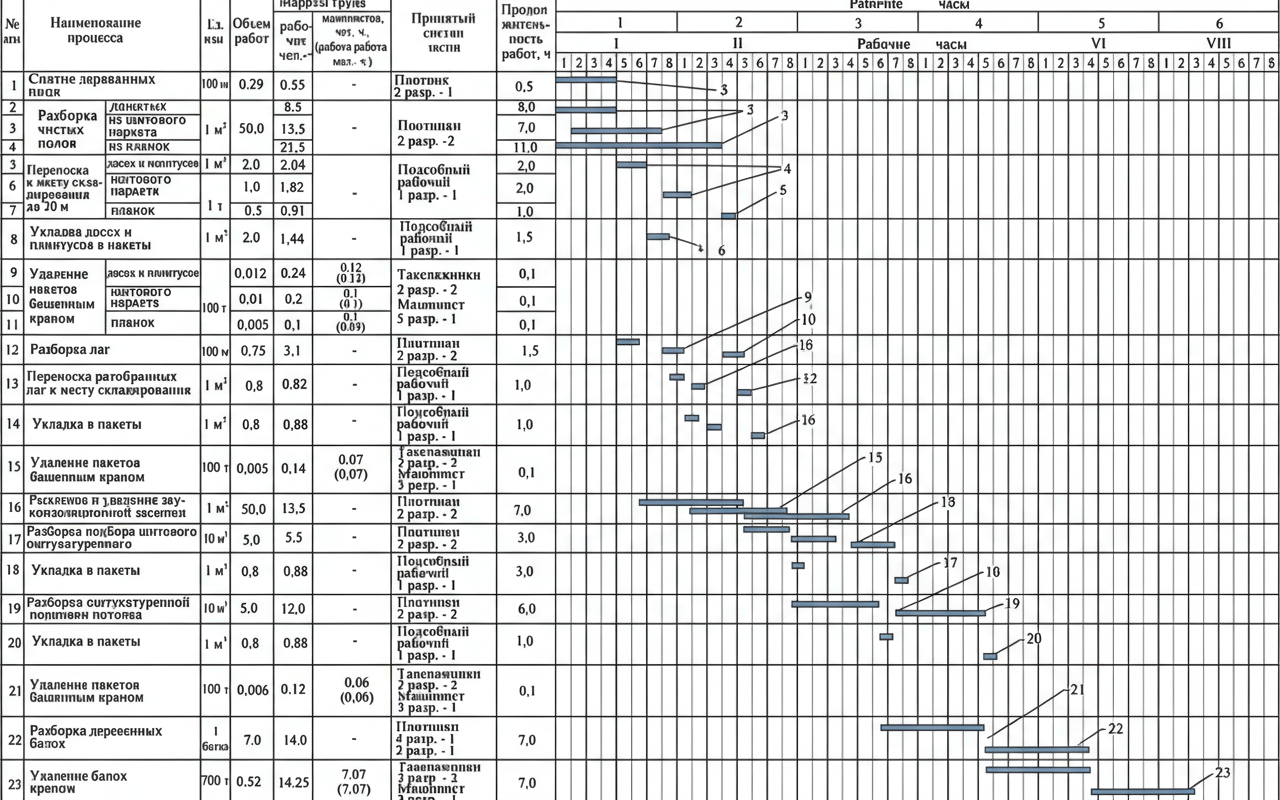
Floor dismantling works are performed by a specialized crew of 7 people. The crew includes: two 4th-grade carpenters, two 2nd-grade carpenters, two 3rd-grade riggers (slingers), and one 2nd-grade general laborer. The personnel must have documentary proof of qualification, undergo a medical examination, and receive a safety briefing on working at heights and interacting with hoisting machinery.
The distribution of duties is optimized for flow production: one carpenter removes skirting boards and grilles; two dismantle the finished floor and sub-boarding; two release the beam ends from the masonry. The sawing of beams is entrusted to the 4th and 2nd-grade carpenters. The riggers hitch the loads, monitor the test lifts, and unhitch at the site storage. General laborers and riggers ensure the immediate cleanup of removed elements, preventing clutter in the working zones.
Quality control includes checking: the completeness of network disconnection, the reliability of temporary tower installation, the quality of commercial timber sorting, and compliance with the dimensions for widening the support pockets in the brickwork. The culling of materials (separating commercial timber from firewood and construction waste) is performed directly at the work section, which reduces logistical costs and complies with modern waste management standards.
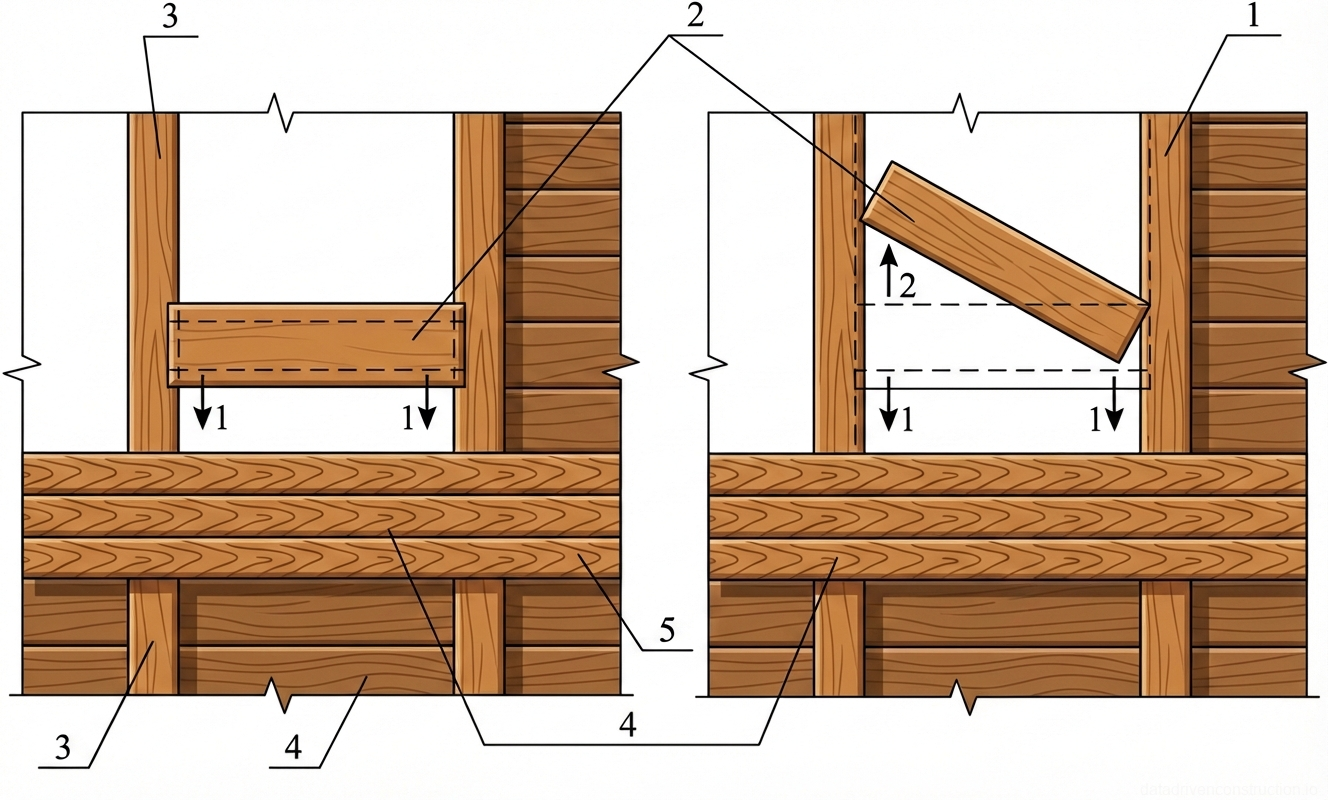
- Conduct a targeted safety briefing for the 7-person crew, distributing tasks for the shift.
- Ensure continuous sorting of waste: commercial timber, firewood, bulk waste.
- Perform operational control of the dimensions of the widened pockets in the brickwork.
- During the crane pause, reassign free workers to prepare the adjacent work section.